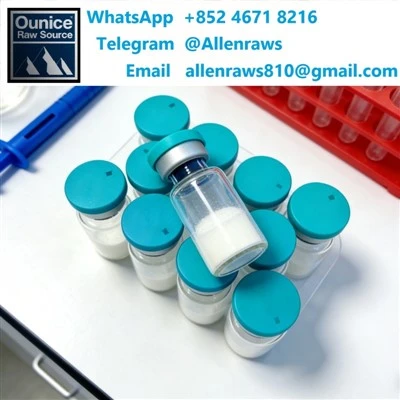

Growth hormone fragment 176-191 2mg/bottle core introduction
Human growth hormone active fragment | Amino acid sequence 176-191 2mg/vial
Generic name : Growth hormone releasing peptide 176-191
Sequence : H-Tyr-Leu-Arg-Ile-Val-Gln-Cys-Arg-Ser-Val-Glu-Gly-Ser-Cys-Gly-Phe-OH
Molecular weight : Approximately 1817.0 Da
Purity : ≥98.5% (HPLC)
Content : 2mg/bottle
Appearance : White lyophilized powder
Storage : Freeze at -20℃, protect from light, and store in a dry place.
Usage and Storage Guide
Growth hormone fragments 176-191:
The growth hormone fragment 176-191 is an active segment of the C-terminus of human growth hormone. It retains the biological function of stimulating lipolysis but produces almost none of the anabolism, bone growth, and glycemic effects of the full-length growth hormone. Unlike full-length growth hormone, this 16-peptide fragment specifically stimulates β-3 adrenergic receptors in adipose tissue, promoting lipolysis, without binding to growth hormone receptors to trigger systemic effects. Its unique "selective lipolysis" characteristic makes it of significant research value in studying localized fat reduction, metabolic regulation, and the mechanisms of obesity treatment.
Due to its well-defined selective fat mobilization function, growth hormone fragment 176-191 is a preferred choice for researchers in many fields of metabolic research, obesity treatment, and exploring the mechanisms of localized fat reduction. It does not act through the classic GH-IGF-1 axis, avoiding the side effects that may occur with intact growth hormone, such as acromegaly, elevated blood sugar, and edema. Its specific targeting of adipocytes makes it a precise research tool with a low risk of side effects when studying the molecular mechanisms of refractory fat metabolism, regional fat distribution, and metabolic syndrome.
Applications of growth hormone fragments 176-191:
It specifically promotes the breakdown of triglycerides in adipocytes and stimulates the release of free fatty acids without affecting bone growth or glucose metabolism. Growth hormone fragment 176-191 is a polypeptide with selective lipolysis function, making it an ideal tool for studying the regulatory mechanisms of lipid metabolism.
Growth hormone fragments 176-191 are widely used in research on lipid metabolism, the pathophysiological mechanisms of obesity, and localized fat reduction strategies. Their specific effects on adipose tissue provide a unique research model for exploring adipocyte signaling pathways, hormone-sensitive lipase activation mechanisms, and the molecular basis of regional fat deposition. They also hold significant importance in evaluating novel fat-reducing compounds and studying the metabolic effects of exercise and nutritional interventions.
Usage and storage methods
1. Reconstitution and preparation :
Recommended solvent :
Preferred solvent : sterile water for injection or sterile phosphate buffer with pH 7.0-7.5
Stability optimization : Sterile PBS containing 0.1% bovine serum albumin (BSA)
For animal experiments : Dilute with sterile physiological saline.
Standard preparation procedure :
Solvent preparation :
Solvents were sterile filtered through a 0.22 μm filter membrane.
Return the solvent to room temperature (20-25℃).
Reconstitution procedure :
Add 1.0 mL of the recommended solvent to a 2 mg vial.
Slowly pour the powder along the bottle wall to avoid direct impact on the powder.
Gently rotate the vial for 2-3 minutes until completely dissolved.
Final concentration: 2 mg/mL (approximately 1.1 mM)
Dispensing and dilution :
Immediately aliquot into 20-50 μL portions using low-absorption cryovials.
Dilute to working concentration with PBS or physiological saline containing 0.1% BSA.
Clear labeling: Product name, concentration, preparation date
Working concentration/dosage reference :
In vitro cell experiments : Commonly used concentration range is 0.1 μM to 10 μM
Animal in vivo experiments : The commonly used dosage range is 50 μg/kg to 300 μg/kg (subcutaneous injection).
Local injection studies : concentration 50-200 μg/mL, 10-50 μL injected at each point.
Example of preparation calculation : If a 10 μM working solution is required, take 9.1 μL of stock solution and add it to 1 mL of culture medium.
Key points to note :
Aseptic technique : All preparation steps are completed within a biosafety cabinet.
Light avoidance requirement : Sensitive to light, requires handling in the dark.
Solubility : Soluble well in water and buffer salt solutions.
To avoid adsorption : use a solution containing carrier proteins for dilution to reduce adsorption loss on the tube wall.
Prepare and use immediately : It is recommended to use within 4 hours after reconstitution.
Handle gently : Avoid violent shaking that may create air bubbles.
2. Storage conditions :
Unreconstituted lyophilized powder :
Long-term storage : Frozen at -20℃, shelf life 24 months
Optimal storage : -80°C (deep freeze), shelf life 36 months.
Light protection requirement : Store in the original aluminum foil bag away from light.
Moisture-proof storage : Built-in desiccant, relative humidity ≤50%.
Reconstituted solution :
immediately after reconstitution for optimal activity.
Short-term storage : Refrigerate at 2-8℃ for no more than 12 hours.
Repackaging and freezing : Repackaging and freezing at -20℃ for no more than 1 month.
Freeze-thaw limit : A maximum of 2 freeze-thaw cycles are allowed.
Transportation conditions :
Cold chain transportation : Dry ice transportation (below -78℃)
Short-term transportation : 2-8℃ ice pack transportation, not exceeding 24 hours.
Packaging standard : Light-proof aluminum foil bag + vacuum seal + insulated box
Shipping labeling : Clearly marked "Bioactive Peptides", "Low Temperature", and "Protect from Light".
3. Stability Management :
Temperature stability :
-80℃: >3 years
-20℃: >2 years
2-8℃: ≤12 hours (solution)
Room temperature: ≤4 hours (solution)
Chemical stability :
Optimal pH range: 6.5-7.5
Avoid environments with strong acids, strong alkalis, and oxidizing agents.
Physical stability :
Avoid violent tremors
Avoid repeated freeze-thaw cycles
Avoid high temperatures and ultraviolet radiation.
Maintenance of bioactivity :
Use low-absorption consumables
Adding carrier proteins reduces nonspecific adsorption
Correct freeze-thaw procedure
Need anything, please contact us
|
|
+852 4671 8216 |
|
Telegram |
Allenraws |
|
|
Allenraws810@gmail.com |

Hot Tags: hgh 176/191(fragment) 2mg/vial targeted promotion of fat metabolism, China hgh 176/191(fragment) 2mg/vial targeted promotion of fat metabolism manufacturers, suppliers, factory, AOD9604 Ideal For Competition Prep Peak Weeks, ace 031 1mg, buy aod 9604 pills, peptide cjc ipamorelin, Alternative to GHRP 6, hgh ipamorelin