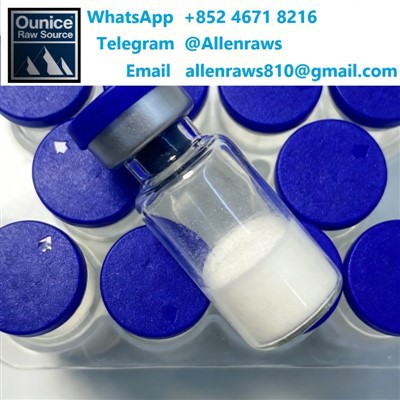

AOD9604 2mg/bottle core introduction
Lipid metabolism regulating peptides | Growth hormone fragment analogue 2mg/vial
Generic name : AOD9604
English name : AOD9604
Sequence : Tyr-hGly-Gln-hGly-Ser-Ser-Ser-Gln-hGly-Ser-Ser-Cys
Molecular weight : Approximately 1158.3 Da
Purity : ≥97.0% (HPLC)
Content : 2mg/bottle
Appearance : White lyophilized powder
Storage : Freeze at -20℃, protect from light, and store in a dry place.
Usage and Storage Guide
AOD9604 (lipid metabolism regulating peptide):
AOD9604 is a modified peptide derived from the C-terminal portion of the human growth hormone (hGH) amino acid sequence, designed to mimic the partial lipolytic activity of hGH while reducing potential growth-related risks. As a synthetic research peptide, it has shown potential regulatory properties on lipid metabolism in experimental models, believed to influence lipid metabolism primarily by stimulating lipolysis and inhibiting lipogenesis. Unlike intact hGH, its structure has been optimized to isolate its lipid metabolism regulatory functions, thus serving as a specialized tool in adipocyte biology, energy balance, and related metabolic disorders research.
Due to its potential to target lipid metabolism regulation, AOD9604 is frequently chosen by researchers in metabolic studies, obesity, and adipose biology. Compared to other broad-spectrum metabolic regulators, its relatively specific focus of action makes it a standardized research reagent in in vitro and animal models for studying white adipose tissue function, evaluating novel strategies to promote lipolysis, and exploring the role of lipid metabolism in obesity and related diseases.
AOD9604 Applications:
As an investigational peptide, it is used in specific experimental models to evaluate its potential impact on adipocyte catabolism (lipolysis) and anabolism (lipogenesis). Its primary purpose is to explore the mechanisms regulating adipose tissue metabolism, energy balance, and obesity-related diseases.
It has been applied in in vitro functional studies of adipocytes (such as 3T3-L1 cells), animal models of diet-induced obesity, and experiments evaluating intervention strategies for metabolic syndrome. Its standardized chemical structure provides a fundamental research tool for studying the molecular pathways of lipid metabolism under controlled conditions and for screening potential metabolic regulators.
Usage and Storage Methods
1. Reconstitution and preparation :
Recommended solvent :
Preferred solvent : Dilute acetic acid solution with pH 4.0-5.0 (e.g., 0.1M acetic acid)
Stability optimization : Sterile acetic acid solution containing 0.1% bovine serum albumin (BSA)
Working solution dilution : Dilute to neutral pH with sterile PBS or cell culture medium containing 0.1% BSA.
Important note : Do not use alkaline solutions (pH>7.5) or pure water to dissolve directly , as this may cause precipitation.
Standard preparation procedure :
Solvent preparation :
Use acidic solvents that have been sterilely filtered through a 0.22 μm filter membrane.
The solvent temperature was restored to room temperature (20-25℃).
Reconstitution procedure :
Add 1.0 mL of the recommended acidic solvent to a 2 mg vial.
Pour slowly along the bottle wall to avoid direct impact on the powder.
Gently rotate the vial for 3-5 minutes until the powder is completely dissolved and the solution is clear.
Final concentration: 2 mg/mL (approximately 1.73 mM) acidic stock solution.
Dispensing and dilution :
Immediately dispense into single-use doses of 10-20 μL using low-absorption cryovials.
Before use, dilute the acidic stock solution to the working concentration with sterile PBS or culture medium containing 0.1% BSA.
Clearly label: name, concentration, pH, preparation date, batch number.
Working concentration/dosage reference :
In vitro cell experiments : The commonly used concentration range is 1 nM to 1 μM, and preliminary experiments need to be performed to optimize the concentration based on the specific cell type and experimental purpose.
Animal studies : The commonly used dosage range is 0.1 to 1 mg/kg/day (intraperitoneal or subcutaneous injection). It is strongly recommended to determine the precise dosage based on the specific research model and literature.
Example of preparation calculation : If a 1 μM working solution is required, take about 0.58 μL of stock solution and add it to 1 mL of culture medium (pH neutralization needs to be taken into account).
Key points to note :
Acidic solubility : It must be dissolved in an acidic environment to ensure solubility and stability.
Handle gently : Avoid swirling or violent shaking; gently rotate to dissolve.
Strict aseptic technique : Operations are performed in a clean bench and sterile consumables are used.
Completely avoid light : It is sensitive to light, and all steps must be carried out under light-protected conditions.
To prevent adsorption : Use a solution containing 0.1% BSA during dilution to reduce adsorption on the tube walls.
2. Storage conditions :
Unreconstituted lyophilized powder :
Long-term storage : Freeze at -20℃, shelf life 24 months.
Optimal storage : -80°C deep freeze, shelf life 36 months.
Strictly protected from light : Must be stored in the original light-proof aluminum foil bag.
Moisture protection : Keep dry; contains desiccant.
Reconstituted solution :
Immediate dispensing : The acidic stock solution should be dispensed immediately after reconstitution.
Frozen storage : After repackaging, store at -80℃ away from light for no more than 1 month.
Working solution : The diluted neutral working solution should be prepared and used immediately, and should be avoided from storage.
Repeated freeze-thaw cycles are strictly prohibited : each dispensing tube may be frozen and thawed no more than once.
Transportation conditions :
Freeze-dried powder : Must be transported under dry ice (-78°C) conditions.
Packaging : Light-proof outer box + high-strength insulated box + temperature monitor.
3. Stability and Processing Standards :
Chemical and physical stability :
It is relatively stable in acidic aqueous solutions (pH 4.0-5.0).
Its solubility decreases at neutral to alkaline pH levels, and it may form a precipitate.
Avoid contact with strong acids, strong alkalis, and oxidizing agents.
Maintenance of bioactivity :
Strictly adhere to the principle of "dissolving in acidic solutions and using in neutral solutions".
Gentle handling and avoiding repeated freeze-thaw cycles are crucial.
Need anything, please contact us
|
|
+852 4671 8216 |
|
Telegram |
Allenraws |
|
|
Allenraws810@gmail.com |

Hot Tags: aod9604 2mg/vial promotes fat breakdown and optimizes body composition, China aod9604 2mg/vial promotes fat breakdown and optimizes body composition manufacturers, suppliers, factory, AOD9604 Ideal For Competition Prep Peak Weeks, ace 031 1mg, buy aod 9604 pills, peptide cjc ipamorelin, Alternative to GHRP 6, hgh ipamorelin